Most “U” network codes are not a sign your car is broken. They’re a sign your car’s computers are busy talking, and occasionally talking over each other, exactly the way they were designed to.
Picture it: you plug in a scan tool and up pops U0100: Lost Communication With ECM/PCM. It sounds like a hostage situation. Your engine computer has gone dark! Who’s driving?!
And yet the car starts, runs, and gets you to lunch. So what gives? To understand U codes, you first need to meet the chattiest network you’ve never heard of, living right inside your dashboard.
Meet the CAN bus: one wire pair, a lot of opinions
A modern car has dozens of small computers, called modules or ECUs. There’s one for the engine, one for the brakes, one for the airbags, one for the radio, one for your heated seats, and probably one whose only job is to feel bad about your tire pressure.
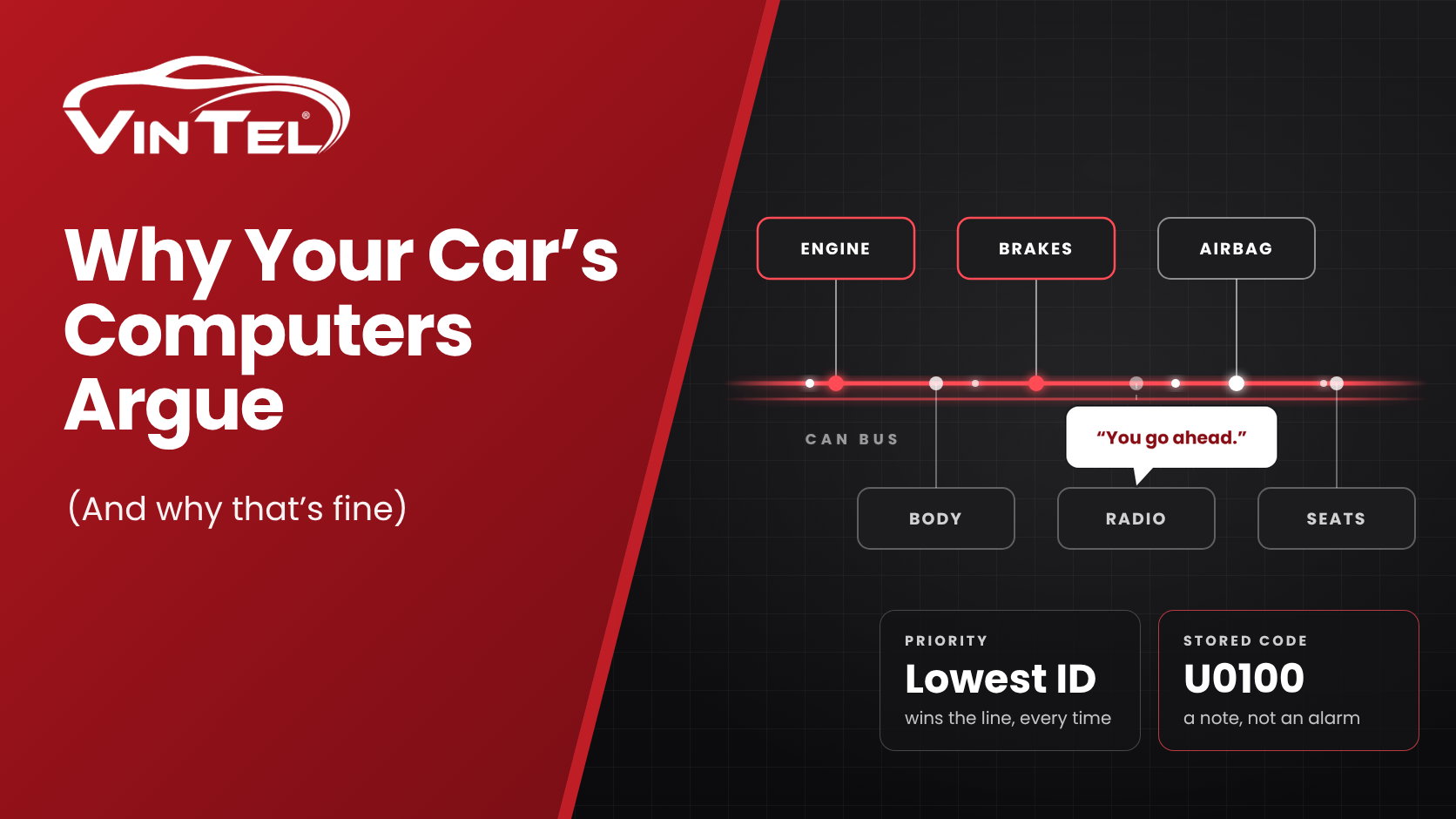
They all share a single conversation line called the CAN bus (Controller Area Network). Think of it as a group chat where everyone posts to the same thread, all the time, hundreds or thousands of times per second.
The engine posts “RPM is 2,100.” The brakes post “wheel speeds look fine.” The dashboard reads both and moves the needles. Nobody sends private messages. Everyone hears everything, and each module just pays attention to the posts it cares about.
There’s one catch: it’s a single line. Only one module can talk at a time. So what happens when two of them want to speak at the same instant?
The priority system: the most important voice wins
When two modules start talking at once, CAN settles it in a few millionths of a second, with no shouting match. Every message starts with an ID number, and that number doubles as its rank. The lower the number, the higher the priority.
Here’s the clever bit. While each module sends its ID, it also listens to the line. The moment a module hears a more important ID than its own, it quietly stops and lets the other one finish. Think of two people starting a sentence together, and one of them goes, “Oh, sorry, you go ahead.”
This means:
- Nothing gets garbled. The winning message goes through perfectly intact.
- The loser isn’t lost. It waits for the next gap and automatically tries again.
- Safety stuff goes first. Engineers give brakes, steering and engine control the low ID numbers. Your seat heater and the radio are further back in line, as they should be. Nobody wants the anti-lock brakes waiting politely for the infotainment screen to finish updating the album art.
On a busy bus, a low-priority module can lose that “you go ahead” moment several times in a row. Usually that’s a delay of a fraction of a millisecond. Most of the time, nobody notices. Most of the time.
How a little waiting becomes a U code
Modules don’t just talk when they feel like it. Many send the same update on a schedule, often every 10 to 100 milliseconds, like a coworker who replies “still here!” to the team chat on a timer.
The modules listening for those updates keep a stopwatch. If an expected message doesn’t show up within its time window, the listener gets worried and writes it down. That note is a U code: “U” for network, followed by a number saying who went quiet. U0100 means “I didn’t hear from the engine computer.” U0121 means “I didn’t hear from the ABS module.” And so on.
Now here’s the important part. The listener has no idea why the message was late. It just knows it was. Maybe the sender was stuck in line behind higher-priority traffic. Maybe the sender was still waking up. Maybe a message got bumped for a moment and came right back. The module logs it anyway, because it’s a dutiful little rule-follower.
So a stored U code often just means: “At some point, for a brief moment, I didn’t hear from my friend.” It’s less a fire alarm and more a sticky note.
Other perfectly normal reasons for a U code
Priority traffic is one reason a message runs late. Real cars have plenty of others, and most are completely harmless:
- Starting the engine. Cranking pulls a huge amount of power from the battery, and voltage briefly sags. Some modules blink out or reset for a split second. Their neighbors notice and take notes.
- Waking up at different speeds. When you unlock or start the car, dozens of modules boot up at once. Some are quick, some are morning people. The quick ones may log that the slow ones were late to the meeting.
- Electrical noise. Cars are full of motors, ignition coils and alternators throwing off interference. CAN is built for this: it checks every message, and if one gets corrupted, every module flags it and the sender automatically sends it again. That self-correction is the system working, not failing.
- Battery work, jump starts and repairs. Disconnecting a battery or unplugging a module for service is a guaranteed way to leave a trail of “where did everybody go?” codes.
- Extra gadgets on the bus. Scan tools, telematics devices and aftermarket add-ons all join the conversation. A busier chat means more chances for someone to wait in line.
None of these mean something is broken. They mean a very busy network handled a hiccup and kept going, with a module dutifully writing it down.
So when should you worry?
We’re not saying every U code is fake news. Wires do chafe, connectors do corrode, and modules do occasionally fail. The trick is telling a sticky note from a real alarm. A U code deserves a closer look when:
- It’s active right now, not just stored from some moment in the past.
- It comes back after the codes are cleared and the car has been driven normally.
- It shows up with symptoms, like warning lights, features that stop working, or a car that won’t start.
- Lots of modules go quiet at once, or the same module is missing every single time you check.
A single stored U code on a car that drives fine, with no warning lights and no repeat appearance? That’s usually just the network’s diary, not its medical chart.
The bottom line
CAN bus was designed to be busy, crowded and a little chaotic, and to stay reliable anyway. Modules take turns by priority, retry when they lose, fix corrupted messages on their own, and keep careful notes about every awkward pause. Those notes are U codes.
So the next time a scan turns up a U code or two, don’t panic. Ask the better questions: Is it current? Does it come back? Is anything actually wrong with how the car behaves? Most of the time, the answer is that your car’s computers had a brief, polite disagreement about whose turn it was, sorted it out in microseconds, and carried on.
Where VinTel comes in: overwatch for your U codes
Asking those questions on every vehicle, every time, is a lot of detective work. That’s exactly the work VinTel does for you.
VinTel’s advanced analytics and cohort analysis tools look at each U code in context. Cohort analysis compares a vehicle against many similar vehicles, so we can tell whether a code is everyday background chatter for that model or something genuinely out of the ordinary. The inconsequential sticky notes get filtered out. The troublesome ones get flagged.
The result shows up in the VinTel Diagnostic Status Report (DSR). Instead of a wall of alarming-looking codes, you get a clear picture of what actually needs attention. Think of VinTel as running overwatch on your reports, so you can stop playing CAN bus detective and get back to what you do best.
A U code is a clue, not a verdict. VinTel helps you tell which clues matter.